

Operator Console
Inspect sessions, approvals, tenants, and persistent instances from the authenticated Node server.
The Node server includes a compact operator console at /admin. It uses the same authentication,
tenant binding, and admin:read permission checks as the admin APIs. Its warm-paper surfaces,
burnt-sienna emphasis, compact controls, and light/dark palette follow the same Fabric family
contract as @fabricorg/ui. The console remains self-contained so loading @fabric-harness/node
never introduces a React or browser-asset dependency.
FABRIC_HARNESS_API_TOKEN="$API_TOKEN" fh dev --port 4317Open http://localhost:4317/admin, enter the API token, and connect. The token is kept in browser
sessionStorage and sent as a bearer header; it is not written to the server-rendered page.
What operators see
The console combines tenant-scoped sessions, durable queue state, persistence health, and only the actions allowed for the authenticated principal. These screenshots are deterministic, sanitized UI states; no client data, workspace token, or environment identifier is embedded in the documentation.
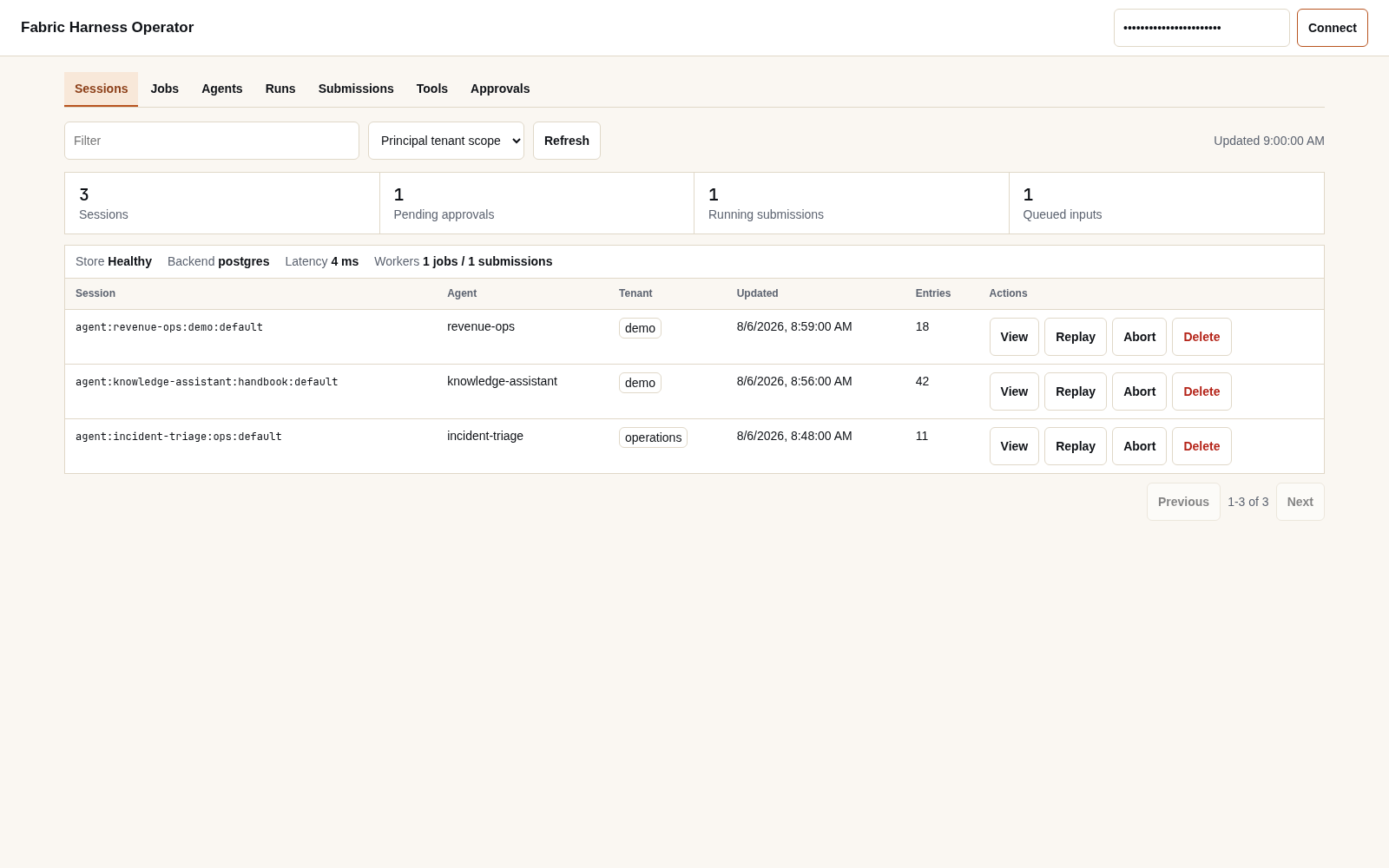
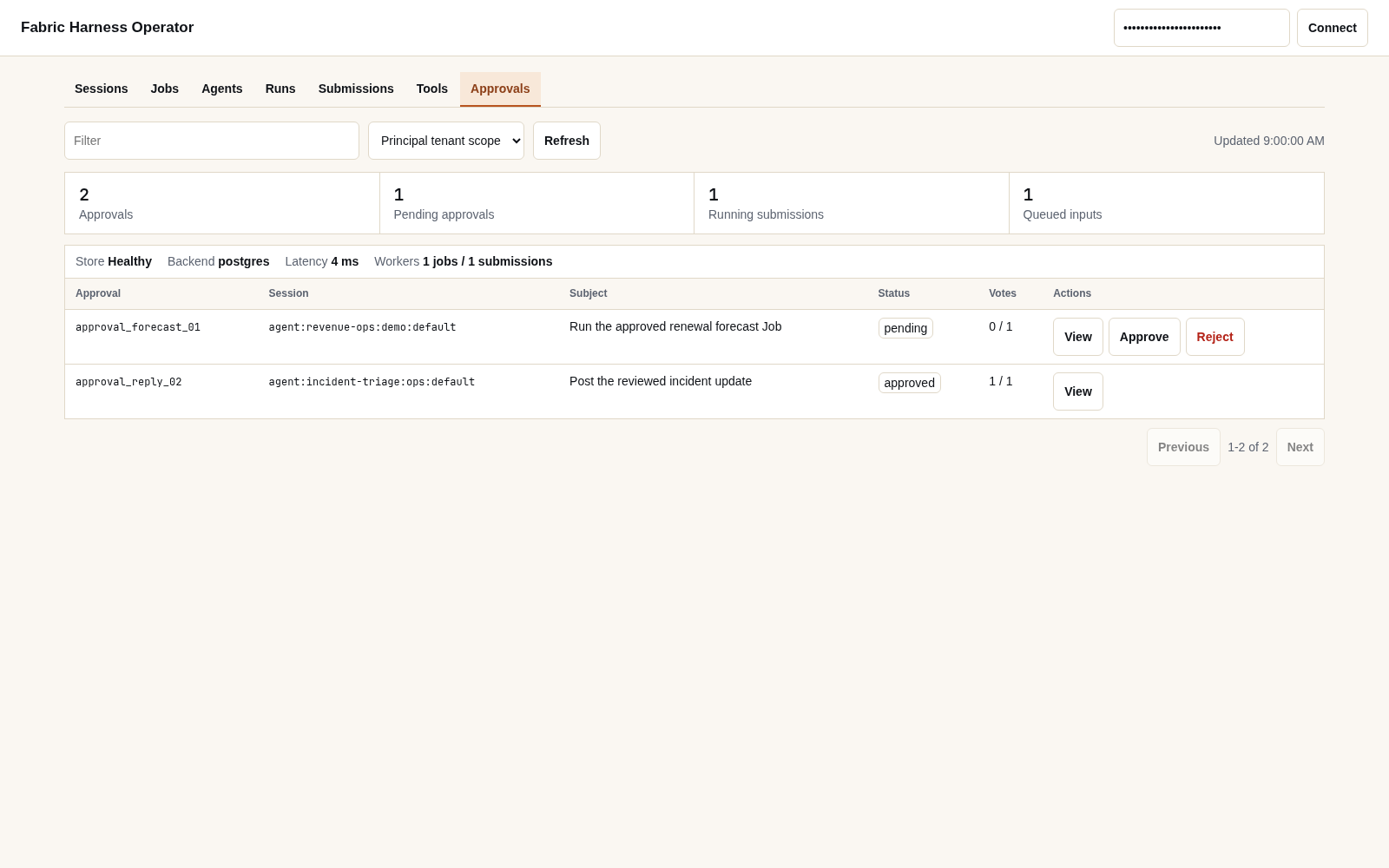
The console provides paginated, searchable views for:
- finite jobs and persistent agents;
- sessions, runs, and active durable submissions;
- built-in tools and pending or completed approvals;
- persistence, queue, and worker health;
- session cost metrics, policy decisions, and the audit trail.
Operators with approval:write can approve or reject a pending request. Operators
with session:replay can fork a session from any durable entry, while
session:abort and session:delete control abort and cascade deletion. Buttons
are hidden when the authenticated principal lacks the corresponding permission;
the server independently authorizes every action.
An application user does not need admin:read merely to handle approvals. Use the tenant-scoped
GET /approvals endpoint or fh approvals --url <app-base-url> to discover visible requests, then
fh approve or fh reject against the same remote URL. The /admin console remains reserved for
operators who need broader run, health, audit, and replay access.
All collection endpoints use the same pagination shape:
{
  "items": [],
  "total": 0,
  "offset": 0,
  "limit": 50,
  "nextOffset": null
}
Use ?offset=0&limit=50&q=running. A tenant-bound principal only receives its
own tenant. A principal allowed to operate several tenants can add ?tenant=acme;
the server validates that selection against the principal before reading data.
Custom SSO deployments should use cookie authentication in authenticate, so the console can load
without a separate bearer token. Assign operators admin:read, plus the action
permissions they need. The APIs remain the source of truth; the console
does not bypass RBAC or tenant isolation.