

RAG on Databricks
Use Databricks-native AI Search and Unity AI Gateway for bounded, citation-validated online RAG with MLflow 3 evaluation records.
Fabric Harness wires Databricks-native products for retrieval, generation, tracing, and evaluation. It does not reimplement AI Search, Unity AI Gateway, the offline index pipeline, or MLflow judges.
Follow the same mental model as the Databricks AI Cookbook RAG inference chain:
- (Optional) preprocess the user query
- Retrieve with Databricks AI Search
- Augment the prompt with retrieved context
- Generate through Unity AI Gateway or a custom Model Serving endpoint
- Validate inline citations and apply answer limits
Offline chunk → embed → index remains a Databricks Job / notebook / Lakeflow concern. Quality measurement uses MLflow 3 evaluation and managed Databricks judges, not a parallel Fabric-only judge product.
Quick start (managed recipe)
fh add databricks rag-chain
# set DATABRICKS_HOST, OAuth credentials, DATABRICKS_AI_SEARCH_INDEX, DATABRICKS_MODEL
fh run rag-answer --question "How do I reset my password?"
For a credential-free local run, add --mock:
fh run rag-answer --question "How do I reset my password?" --mockThe generated recipe then selects its deterministic retriever and model fixture. This exercises
discovery, input/output validation, the RAG chain, and citation handling without calling AI Search
or Model Serving. Remove --mock to use the configured Databricks index and model.
Scaffolded files:
| Path | Role |
|---|---|
.fabricharness/databricks/rag-chain.ts | createRagChain() + evaluationArtifacts() |
.fabricharness/jobs/rag-answer.ts | Finite job calling the chain |
Related recipes:
| Recipe | Use when |
|---|---|
fh add databricks ai-search | Bundle-only / agentic search tool (multi-tool agents) |
fh add databricks rag-chain | Fixed online inference chain (cookbook path) |
fh add lakeflow / Jobs | Offline pipeline ops (index refresh), not the chain itself |
Code API
Deterministic chain (cookbook online path)
import { databricksRagChain, toMlflow3EvaluationRecord, exportMlflow3EvaluationJsonl } from '@fabric-harness/databricks';

const chain = databricksRagChain({
  databricks: {
    host: process.env.DATABRICKS_HOST!,
    principal: { kind: 'pat', token: process.env.DATABRICKS_TOKEN! },
    model: 'system.ai.gpt-oss-20b',
    aiSearch: {
      index: 'main.support.kb_index',
      textColumn: 'chunk',
      idColumn: 'id',
      inputMode: 'text',
      strategy: 'hybrid',
    },
  },
  retrieval: { k: 5, scoreThreshold: 0.25 },
  postProcess: {
    requireCitations: true,
    citationRepairAttempts: 2,
  },
});

const turn = await chain.invoke({ question: 'How do I reset my password?' });
// turn.answer, turn.sources, turn.citations, turn.retrieval, turn.usage
With requireCitations, Fabric asks the model to revise an uncited answer or an answer that cites an
unknown ID using only the exact source IDs returned by retrieval. Repair is bounded and fails closed
if the model still omits a valid marker or retains a fabricated ID; Fabric never adds a citation to
the answer on the model's behalf.
Complete AI Search query controls
Text input uses native HYBRID retrieval by default. Query representation and retrieval strategy
are separate:
const result = await bundle.retriever.query('quarterly retention', {
  inputMode: 'text',
  strategy: 'hybrid',       // ann | hybrid | full-text
  k: 20,
  filter: { language: 'en' },
  scoreThreshold: 0.35,
  queryColumns: ['chunk', 'title'],
  sortColumns: ['published_at DESC'],
  facets: ['language', 'product'],
  reranker: { model: 'databricks_reranker' },
  columnsToRerank: ['title', 'chunk'],
  signal: abortController.signal,
});

result.chunks;
result.facetResult;
result.nextPageToken;
result.response; // complete generated-SDK response
Use inputMode: 'vector' with strategy: 'ann' for a self-managed embedding index. Supply an
embeddingEndpoint when configuring the bundle or provide a precomputed queryVector for a
specific request. text-and-vector sends both inputs for a supported native strategy.
The same controls can be defaults on databricksRagChain({ retrieval: ... }) or per-turn:
const turn = await chain.invoke({
  question: 'What changed?',
  retrieval: {
    strategy: 'hybrid',
    k: 12,
    facets: ['release'],
    reranker: { model: 'databricks_reranker' },
  },
});
Pagination and facet metadata are retained on RagTurn.retrieval. For direct search calls,
retriever.nextPage(token, { signal }) retrieves the following page.
Streaming
chain.stream() yields incremental delta events while the model generates, then one terminal
turn event carrying the same validated RagTurn that invoke returns:
for await (const event of chain.stream({ question: 'How do I reset my password?' })) {
  if (event.type === 'delta') process.stdout.write(event.textDelta);
  if (event.type === 'turn') persist(event.turn); // validated answer, citations, usage
}
Deltas are raw first-pass model output for live UI — they are emitted before citation
validation, bounded repair, truncation, and the sources footer run, so the concatenated deltas can
differ from the final answer. The terminal turn is authoritative: use it for persistence,
evaluation export, and cost telemetry. A failed citation validation raises from the iterator after
the deltas were observed. When the model provider does not implement stream(), the chain falls
back to generate() and emits the whole answer as one delta.
The protected rag certification check uses this streaming path against the configured live AI
Search index and Databricks model endpoint. It requires text deltas, a terminal turn, retrieved
context, and at least one valid inline citation.
Release run 29622641870 certified the exact 2.0.0 package candidate in the protected Azure
eastus2 workspace: the streaming chain emitted 12 text deltas, retrieved three source chunks,
returned a valid fabric-databricks citation, and produced its authoritative terminal turn. The
same run completed Databricks Job 613907318899842 for the managed 50-case RAG evaluation with a
SUCCESS result. Agent Mode was not configured in that workspace and is not implied by this RAG
evidence.
That record predates the 3.0 native-SDK transport and is historical for 3.0 promotion. The 3.0 release gate reruns the same retrieval, streaming, citation, and managed-evaluation checks against the exact package artifact.
What runs under the hood:
| Step | Databricks product | Fabric helper |
|---|---|---|
| Retrieve | Databricks AI Search | databricksAiSearch / UC principal |
| Generate | Unity AI Gateway / Model Serving | databricksFoundationModelProvider |
| Orchestrate | — | databricksRagChain (thin glue only) |
Agentic multi-tool RAG
When the agent must also call SQL, Genie, or Jobs, keep tool-calling:
const chain = databricksRagChain({ databricks: { /* + aiSearch */ } });
const { modelProvider, tools, policy } = chain.asAgentTools();
// pass into init({ modelProvider, tools, policy })
Or continue using databricks({ aiSearch }) + bundle.tools as in examples/with-databricks-rag.
Evaluation and quality (native Databricks first)
Local CI smoke (optional)
Lightweight checks on a RagTurn validate actual [source-id] markers, required facts, and retrieval:
import { scoreRagTurn, toMlflow3EvaluationRecord, exportMlflow3EvaluationJsonl } from '@fabric-harness/databricks';

const scores = scoreRagTurn(turn, {
  mustContain: ['Settings'],
  requireCitations: true,
  mustRetrieveIds: ['doc-1'],
});
These are smoke scorers, not a substitute for managed evaluation.
What developers inspect
Keep the answer and its source references visible beside quality evidence. The representative state below shows the relationship between retrieved context, citations, managed judges, latency, and cost; replace the fixture corpus and expected facts with the application's governed domain data.
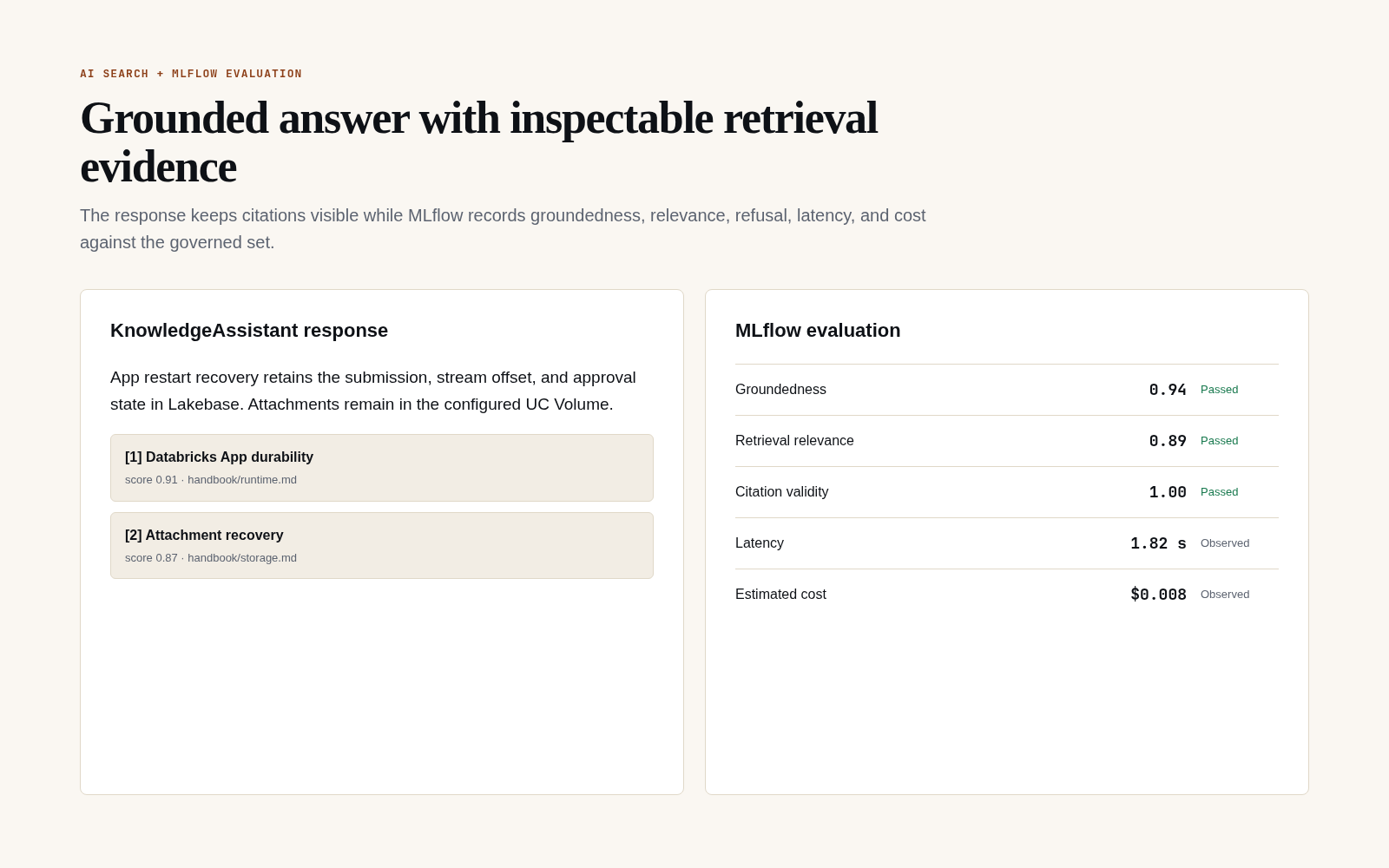
MLflow 3 managed evaluation
Export MLflow 3 rows with structured inputs, outputs, expectations, retrieved context, and trace metadata:
const record = toMlflow3EvaluationRecord(turn, {
  expectedAnswer: 'Use Settings, then Security.',
  traceId: 'tr-...',
  submissionId: 'sub-...',
});
const jsonl = exportMlflow3EvaluationJsonl([record]);
// Merge the record into an MLflow Evaluation Dataset from a Databricks notebook or job.
The release certification fixture runs this loop as a serverless Databricks Job. The notebook at
scripts/databricks/rag_evaluation.py queries five candidates from the real AI Search index,
uses the configured Databricks model to retain only sources that supply relevant or complementary
evidence, records the filtered documents in the retriever span, and generates a citation-backed
answer. It merges the governed 50-case golden set into a content-hashed Unity Catalog evaluation
dataset, so changed fixtures cannot inherit stale rows from an earlier release, and runs the
following managed judges:
| Case category | Count | Purpose |
|---|---|---|
| Factual | 30 | Paraphrased questions over individual governed documents |
| Multi-document | 10 | Answers that must combine identity, governance, runtime, deployment, or RAG evidence |
| Insufficient context | 5 | Unsupported questions where the correct behavior is to abstain |
| Adversarial | 5 | Retrieved prompt-injection text that must be treated as untrusted data |
The source documents and cases live together in scripts/databricks/rag_fixture.json. The
provisioner merges those documents into the Delta source table, triggers the AI Search index,
and embeds the same cases into the evaluation notebook. This prevents the index fixture and golden
set from drifting apart.
| Judge | What it catches |
|---|---|
| Relevance to query | The answer does not address the request |
| Retrieval relevance | Retrieved chunks add irrelevant context |
| Retrieval groundedness | Retrieved claims are not supported by the source chunks |
| Retrieval sufficiency | Retrieval omitted context needed to answer |
| Correctness | The answer misses the expected facts |
Each aggregate must meet DATABRICKS_RAG_EVAL_THRESHOLD (default 0.8). Evidence includes the
MLflow run, versioned dataset and fixture hash, generation and judge models, category counts,
selected aggregate metrics, and threshold result. A failed judge fails the Databricks Job and
therefore the release certification gate.
The protected release workflow for commit 5fcf927bcf0a3a15e3aec86e2629516cbb76ad26
evaluated fixture 18bd4dffc32c as MLflow run 18131356bcac4460a26de20d40b9573a in the
reference Azure workspace. It covered all 50 cases with databricks-gpt-oss-120b for generation
and managed judging, and passed the unchanged 0.8 floor:
| Metric | Score |
|---|---|
| Relevance to query | 0.86 |
| Retrieval relevance | 0.895 |
| Retrieval groundedness | 0.84 |
| Retrieval sufficiency | 0.86 |
| Correctness | 0.88 |
This is retained workspace evidence for the reference fixture, not a claim that every application or dataset will achieve the same scores. Replace the documents, question-level expected facts, and adversarial cases with your domain corpus before treating the gate as production evidence.
Text alternative and Mermaid source
Diagram flow: UC golden dataset<br/>content-hashed version leads to Serverless evaluation Job; J leads to AI Search<br/>top five candidates; V leads to Model-assisted reranker<br/>relevant sources only; R leads to MLflow retriever span; T leads to AI Gateway generation<br/>bounded context and citations; T leads to Five MLflow managed judges; M leads to E; E leads all scores at least 0.8 Release evidence; E leads score below threshold Block release; F leads to Diagnose retrieval, prompt, or index; D leads to J.
flowchart LR
  G[UC golden dataset<br/>content-hashed version] --> J[Serverless evaluation Job]
  J --> V[AI Search<br/>top five candidates]
  V --> R[Model-assisted reranker<br/>relevant sources only]
  R --> T[MLflow retriever span]
  T --> M[AI Gateway generation<br/>bounded context and citations]
  T --> E[Five MLflow managed judges]
  M --> E
  E -->|all scores at least 0.8| P[Release evidence]
  E -->|score below threshold| F[Block release]
  F --> D[Diagnose retrieval, prompt, or index]
  D --> J

  classDef source fill:#dcfce7,stroke:#16a34a,color:#052e16
  classDef gate fill:#fef3c7,stroke:#d97706,color:#422006
  classDef fail fill:#fee2e2,stroke:#dc2626,color:#450a0a
  class G,V,R,T,M source
  class J,E,P gate
  class F,D fail
Provision or repair the disposable fixture, then run the same gate used by protected CI:
FABRIC_DATABRICKS_PROVISION=1 pnpm databricks:cert:provision
pnpm databricks:certify
The provisioner is idempotent: it reuses the UC dataset, Jobs, AI Search index, Feature Serving
endpoint, Genie Agent, and Lakeflow pipeline. Improve quality by diagnosing retrieval versus
generation, changing topK, prompts, chunks, or embeddings, and rerunning the managed judges before
redeploying Apps or Model Serving.
The default job limits MLflow to one prediction worker and one scorer worker, with prediction and
scorer rate limits, so pay-per-token endpoints do not exceed workspace output-token quotas. Raise
MLFLOW_GENAI_EVAL_MAX_WORKERS, MLFLOW_GENAI_EVAL_MAX_SCORER_WORKERS,
MLFLOW_GENAI_EVAL_PREDICT_RATE_LIMIT, or MLFLOW_GENAI_EVAL_SCORER_RATE_LIMIT only when the
workspace uses capacity that supports the additional concurrency.
Do not build a second full judge product in Fabric when MLflow managed evaluation already exists in the workspace.
Offline index pipeline (not the chain)
Building/updating the AI Search index (chunking, embedding, write) stays on Databricks:
- Notebooks / Jobs
- Lakeflow pipelines (
fh add lakeflow) - UC Volumes as document sources
Fabric agents consume the index via AI Search at inference time.
Guardrails
| Concern | Prefer |
|---|---|
| Data access | Unity Catalog grants on the index + service principal |
| Tool / SQL risk | databricks() governance policy / approvals |
| Content policy / gateway | Mosaic AI Gateway / serving policies (configure on the endpoint) |
| Audit | MLflow traces (bundle.mlflowTraceExporter()) + lineage hooks |
The default chain treats retrieved chunks as untrusted data, serializes them as bounded JSONL,
limits per-chunk and total context size, and rejects citation markers that do not match a retrieved
source. turn.sources means "retrieved"; only source IDs referenced by the final answer appear in
turn.citations.
const chain = databricksRagChain({
  databricks: { /* model + aiSearch */ },
  topK: 5,
  maxContextChars: 32_000,
  maxChunkChars: 8_000,
  postProcess: {
    citationPolicy: 'validate',
    maxAnswerChars: 8_000,
  },
});
See also
Databricks recipes (`fh add`)
Scaffold Genie analytics copilots, Lakebase, SQL, AI Search, Lakeflow, Jobs, cost controls, and Apps wiring with managed Fabric Harness recipes.
Databricks integrations
Complete map of Fabric Harness integrations for Databricks data, AI, orchestration, state, governance, telemetry, and cost.