

Deployment Overview
Build targets and where to run them.
fh build produces a deployable artifact for a chosen target. The same agent code runs on every target — only the build output and runtime differ.
Targets at a glance
| Target | What it produces | Deployment requirement | Best for |
|---|---|---|---|
| Node | dist/server.mjs HTTP server | Configure auth, durable stores, limits, and monitoring. | Local services, internal automation, container wrapping. |
| Docker | Dockerfile + Node bundle | Configure registry, secrets, network policy, and persistent stores. | CI smoke tests, ECS / Kubernetes, generic container hosts. |
| AWS | Docker artifact for ECS/App Runner/EKS | Provision the AWS container control plane around the artifact. | AWS container platforms with external durable state. |
| Fly.io | Docker artifact | Configure the application, secrets, port, health checks, and volume/database. | Regional container applications. |
| Railway | Docker artifact | Configure service variables, port, health checks, and durable database. | Managed container deployment. |
| SST | Node/Docker artifact | Provision a long-running AWS container service. | AWS infrastructure defined from TypeScript. |
| Temporal worker | Worker entrypoint + activities | Provide a Temporal namespace, task queue, identity, and worker operations. | Durable, replayable, approval-gated agent sessions. |
| Cloudflare Workers + Sandbox | Worker + DO + Sandbox container binding | Configure Worker, Durable Object, R2, and optional Sandbox bindings. | Edge-triggered webhooks, per-tenant Durable Object sessions. |
| Foundry Hosted Agents | Dockerfile + azure.yaml + Bicep; Agent Service client/tools | Configure Azure identity, role assignments, project, networking, and region. | Azure-native agents with per-session isolation, Entra Agent ID, OBO auth. |
| Azure Container Apps / ACI / AKS | ARM control-plane tools; Docker deploy path | Configure subscription identity, registry, network, and compute resources. | Azure customers without Foundry availability or with K8s mandates. |
| Databricks | Databricks App/Serving artifacts, governed tools, OAuth, and Lakebase stores | Configure workspace identity, UC grants, App resources, and certification. | Data, analytics, ML, and governance agents. |
| E2B | Control-plane helpers for E2B sandbox runtime | Provide provider credentials and validate lifecycle and cleanup. | Ephemeral sandbox execution for untrusted code. |
| Daytona | Control-plane helpers for Daytona workspace runtime | Provide provider credentials and validate workspace lifecycle. | Reproducible dev environments as agent sandboxes. |
| Modal | Native TypeScript SDK sandbox adapter | Configure Modal credentials, image, resources, network policy, and cleanup. | Serverless GPU/CPU tasks from agent sessions. |
| Azure Container Instances (ACI) | ARM control-plane helpers for ACI | Configure ACR, managed identity, resource group, and networking. | Lightweight container instances for single-shot agents. |
What remains portable
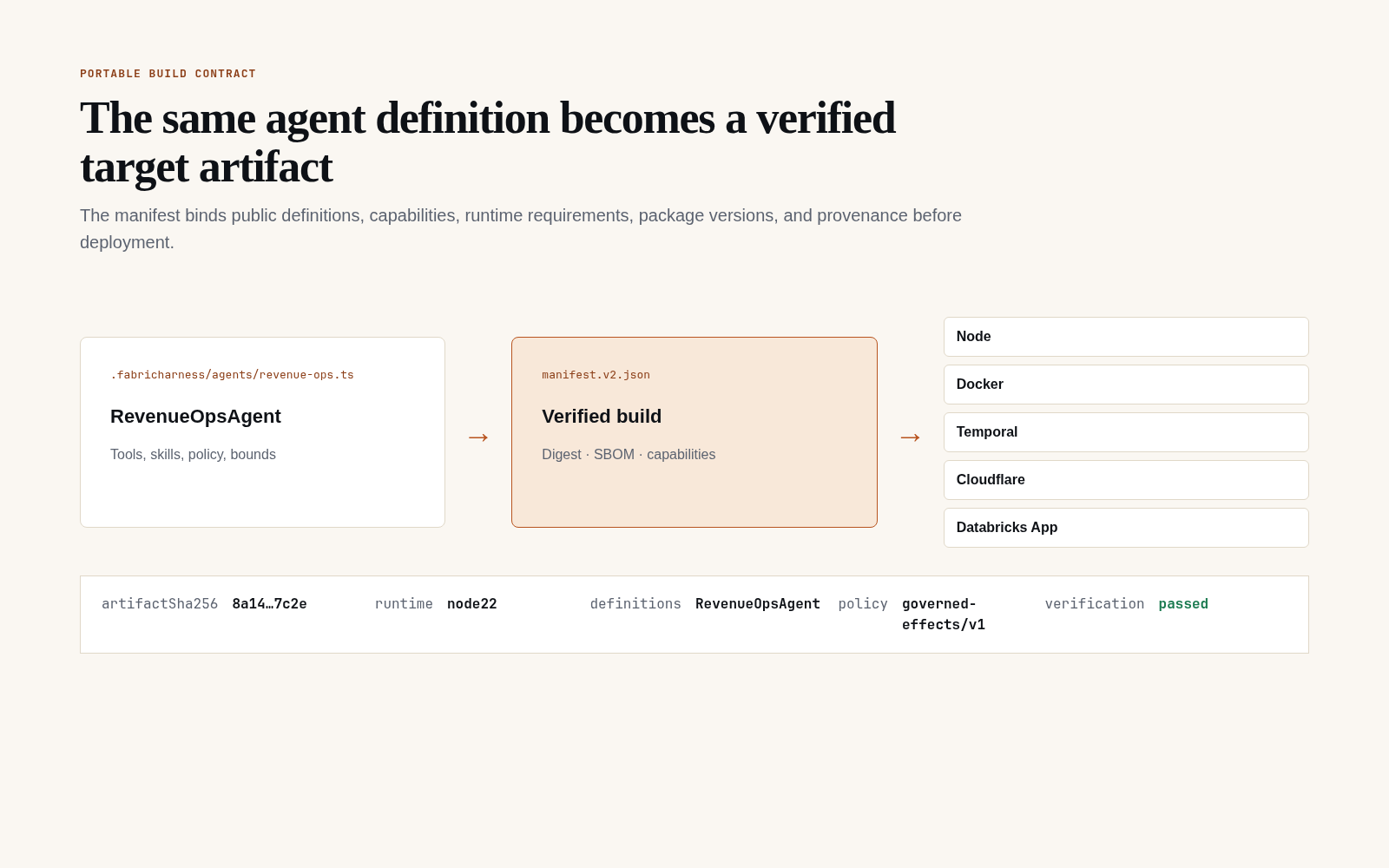
The source definition stays the same while the build manifest records the selected runtime, capabilities, policy, package versions, digest, and provenance for the target-specific artifact.
How to choose
Text alternative and Mermaid source
Diagram flow: graph TD; Where will the agent run? leads to Local / on-prem?; Local leads Yes Node; Local leads No Cloud preference?; Cloud leads Edge / per-tenant Cloudflare; Cloud leads Azure-native Foundry available?; Azure leads Yes Foundry Hosted Agent; Azure leads No Azure Container Apps; Cloud leads Data / ML Databricks tools; Cloud leads Other Docker / K8s; Cloud leads Serverless GPU/CPU Modal; Cloud leads Ephemeral sandbox E2B.
graph TD
    Start[Where will the agent run?] --> Local{Local / on-prem?}
    Local -->|Yes| Node
    Local -->|No| Cloud{Cloud preference?}
    Cloud -->|Edge / per-tenant| Cloudflare
    Cloud -->|Azure-native| Azure{Foundry available?}
    Azure -->|Yes| Foundry[Foundry Hosted Agent]
    Azure -->|No| ACA[Azure Container Apps]
    Cloud -->|Data / ML| Databricks[Databricks tools]
    Cloud -->|Other| Docker[Docker / K8s]
    Cloud -->|Serverless GPU/CPU| Modal[Modal]
    Cloud -->|Ephemeral sandbox| E2B[E2B]
    Cloud -->|Reproducible dev env| Daytona[Daytona]
    Cloud -->|Lightweight containers| ACI[Azure Container Instances]
    Node --> Durable{Need durability?}
    Durable -->|Yes| Temporal[+ Temporal worker]
    Durable -->|No| NodeOnly[Node server]
Build invocation
fh build --target node
fh build --target docker --docker-build --docker-tag myorg/agents:latest
fh build --target temporal-worker
fh build --target cloudflare
fh build --target foundry-hosted-agent
fh build --target databricks-app
fh build --target databricks-serving
Each target writes to .fabricharness/build/<target>/ and emits a manifest.json next to the artifact. See Build manifest.
For the v2 artifact layout, route examples, and production environment controls, follow Build and run artifacts. For an end-to-end workspace deployment, use the Databricks App tutorial.
CI/CD recipes
- GitHub Actions — build, sign, deploy on push.
- GitLab CI — equivalent pipeline.
Hardening checklist
Before promoting any target to production, walk through Security hardening: provenance, attestation, secret handling, network egress, approval gating, and rate limits.